
 Related Topics
 Environmental Cleanup
Following the model of the “Salute to the Sea” initiative, establish a division of responsibilities among land-managing authorities for the cleanup of litter and cigarette butts.
Through cigarette butts off the ground campaigns organized by governments at all levels, provide Green Points or tangible rewards to encourage members of the public to collect and remove cigarette butts.
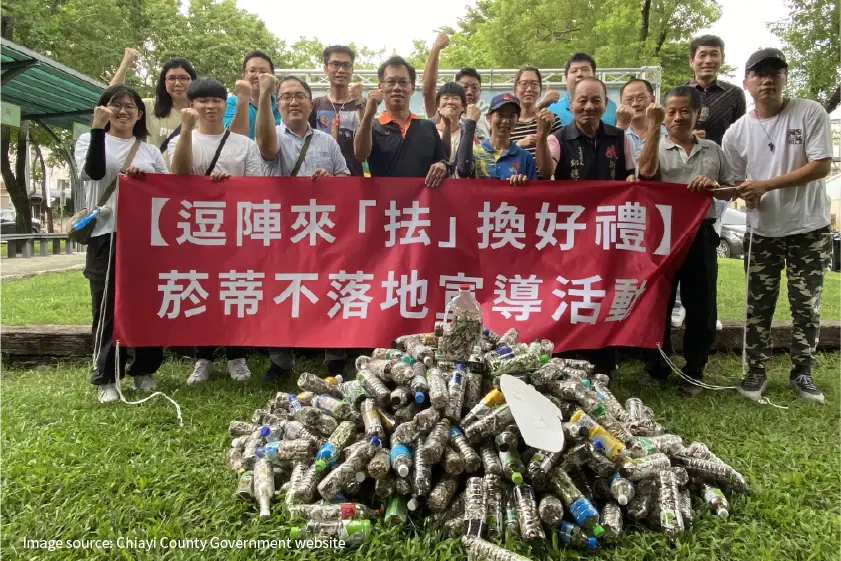
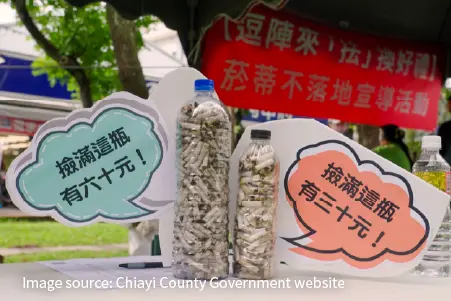
Common cigarette butt hotspots include sidewalks, alleys, roads, and ditches surrounding convenience stores, barbecue restaurants, internet cafés, hospitals and clinics, real estate agencies, transportation hubs, and parking lots, where cigarette butts tend to accumulate.
Efforts will be strengthened to promote the concepts of environmental stewardship and responsibility among businesses. In the initial stage, businesses will be encouraged to conduct voluntary cleanups. In the medium term, inspection and enforcement measures will be strengthened. Over the long term, authorities will evaluate expanding the officially designated cleanup areas through public announcements.
In 2024, approximately NT$18 million was budgeted to continuously assist local governments in gradually replacing aging drain-cleaning vehicles. Based on a regional cooperation approach, subsidies are also provided to strengthen the implementation of local drainage maintenance work. As of the end of April 2024, there were 370 drain-cleaning vehicles nationwide. In the future, subject to available funding, a leasing model may be adopted in place of direct procurement, with drain-cleaning service fees budgeted accordingly, thereby fostering the development of a drain-cleaning service industry.
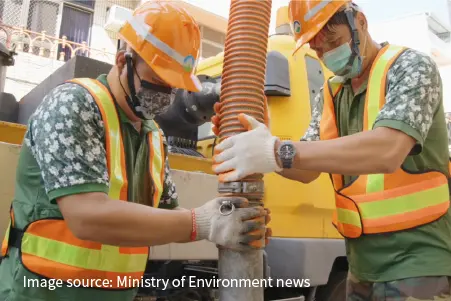
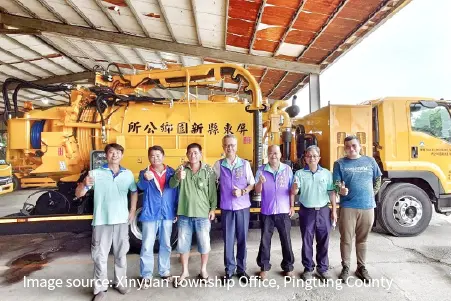
Cigarette butts may be blown by the wind or intentionally discarded into local tributary drainage systems and irrigation channels. As rainfall intensity increases, they are carried into major drainage systems and rivers. Influenced by tidal movements, they may become stranded along shorelines or flow into the ocean.
The Ministry of Environment (MOENV), the Ministry of Economic Affairs’ (MOEA) Water Resources Agency, and the Ministry of Agriculture (MOA) jointly carry out river waste interception operations to remove waste (including cigarette butts) floating in surface waters as part of river pollution remediation measures, preventing waste from interfering with the operation of flood control infrastructure and protecting aquatic ecosystems.
The MOEA’s Water Resources Agency and MOA’s Irrigation Agency install debris interception cables and remove river surface waste from centrally managed regional drainage systems and irrigation canals. The MOENV provides subsidies to local governments for the removal of river surface waste (including cigarette butts) and has established a performance evaluation mechanism for surface water waste interception. Evaluation targets include river management branches under the Water Resources Agency, management offices of the Irrigation Agency, and all special municipalities and county (city) governments.
Coastlines are susceptible to the accumulation of driftwood and litter due to human activities, terrain, and tidal influences, which can degrade environmental quality and scenic landscapes.
Statistics for the past six years (2018 to 2023) show that approximately 10,000 beach cleanup activities are conducted annually, with around 180,000 participants each year. Since the launch of the Salute to the Sea initiative, the volume of waste collected during beach cleanups has gradually declined. The annual amount of waste collected by the public decreased from 3,702 metric tons in 2018 to 3,067 metric tons in 2023, reflecting an overall reduction of approximately 17%. Many civil organizations have also reported that coastlines are now cleaned regularly and that alternative sites must be found for beach cleanup activities, demonstrating that the Salute to the Sea policy has indeed helped make Taiwan's coastlines progressively cleaner.
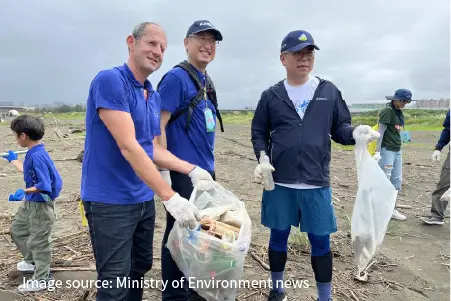
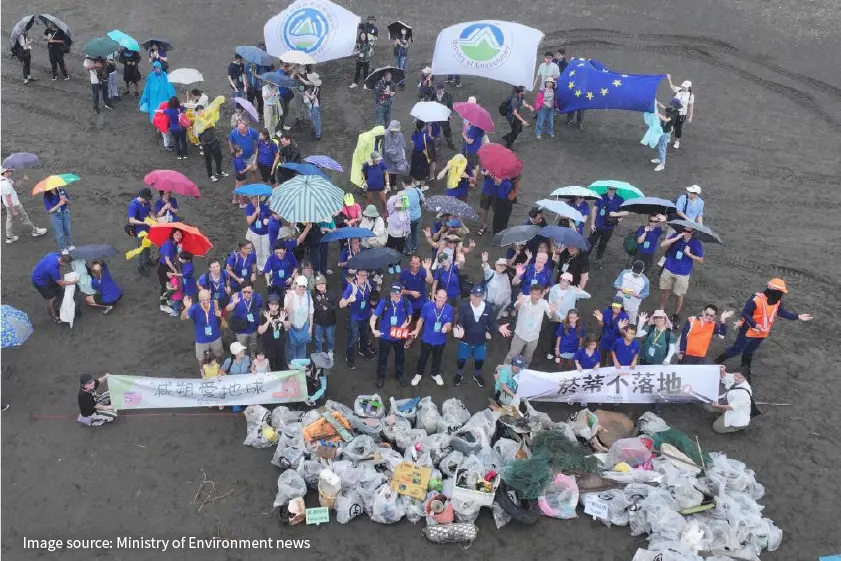
To better understand the composition of coastal waste, the MOENV has, since 2018, conducted pilot coastal waste characterization surveys in 19 coastal counties and cities nationwide, based on the International Coastal Cleanup (ICC) methodology developed by the U.S. Ocean Conservancy. ICC surveys use visual observation to count waste items within selected sampling areas according to standardized categories. The resulting data are compiled to educate the public about the severity of marine pollution caused by waste. Nationwide ICC survey results from beach cleanup activities declined from 15,151 recorded items in 2018 to 4,323 in 2023. Cigarette butts and lighters accounted for approximately 3.7% of the recorded items.
To achieve the goal of permanently clean beaches, coastal management responsibilities have been clearly defined and cleanup mechanisms established. Cross-ministerial coordination has been promoted under the leadership of the MOENV, which coordinates the efforts of nine ministries, 15 agencies, and 19 local governments. Guided by the principles of “regular cleanup,” “immediate cleanup,” and “emergency cleanup,” these entities jointly carry out coastal cleanup and management work to ensure that every stretch of coastline is managed and kept clean.
The MOENV provides subsidies to local governments to conduct coastal inspections and cleanup operations, as well as selected coastal waste surveys.
The Ministry of Environment is promoting the "National Cigarette Butts Off the Ground Program" mainly through six major strategies and 21+N measures: "Changing Culture," "Source Reduction," "Inspection and Enforcement," "Environmental Cleanup," "Public-Private Cooperation," and "Strengthening Research." The aim is to keep our living environment clean and healthy and our ecological environment clean and sustainable.
The effort begins with cultural change, with the hope that smokers will develop good habits at the source: fully extinguishing cigarettes, not smoking while walking, and throwing cigarette butts into trash cans. Change is promoted by shaping social norms, encouraging mutual reminders, and working together in practice.
Taiwan's tobacco product sales in 2025 were about 36.5 billion sticks. If one-quarter of cigarette butts are littered, more than 9.1 billion cigarette butts may enter the environment each year. Discarded cigarette butts consist of three parts: residual tobacco, filters, and paper wrappers. Filters are made of cellulose acetate, a durable artificial plastic that does not biodegrade after being discarded in the environment and may take 10 years or longer to break down. Residual tobacco contains more than 7,000 harmful chemicals, including nicotine, arsenic, lead, copper, chromium, cadmium, and polycyclic aromatic hydrocarbons. The chemical mixture released contains toxic and carcinogenic substances. When these substances enter soil, water bodies, lakes, and oceans, toxins leach from cigarette butts, affecting the environment and marine ecosystems. Research has also shown that smoked cigarette butts and nicotine leachate can be lethal to fish. One cigarette butt in one liter of water can kill half the fish, allowing toxins to enter the food chain and harm both the environment and public health.
When cigarette butts are carelessly discarded, they can travel through drains or storm sewers, then through waterways and rivers to beaches or the ocean. They pollute the environment and are sometimes eaten by seabirds or marine mammals, posing an ecological threat comparable to plastic waste.
Cigarette butt litter remains common in daily environments, affecting city appearance and environmental quality while continuing to harm rivers, oceans, and ecosystems.


- Data Source: Division of Environmental Sanitation
- Publish Date: 2026-08-13
- Update Date: 2026-08-14