
 Related Topics
 GHG Reduction Strategies
After the closing and rehabilitation of landfills, solar panels may be installed on them to support the central government's 2025 energy transition policy, combining waste treatment facilities with solar panels, enhancing public land space reuse, and promoting environmental protection and green energy's dual development. This gradually transforms closed landfills phasal use to green energy, solar power generation or other uses, providing the public an environmental-friendly living space, thus realizing the vision of environmental protection.
Taiwan's Energy PolicyThe administration strives to facilitate the installation of solar power systems in suitable closed, rehabilitating public landfills to promote the administration's policies. To ensure energy safety, green economy, and environmental sustainability, the Executive Yuan passed the "Green Energy Technology Industry Innovation Promotion Program" in 2016, in which a goal involving the administration is to have closed, rehabilitated landfills and other public environmental protection facilities reach 1 million-megawatt capacity by the end of 2025.
Solar Photovoltaic Transformation of Environmental Protection FacilitiesTo promote the green transition while balancing ecological protection and diverse land use, the administration has actively identified public environmental protection facility sites nationwide with potential for solar photovoltaic (PV) installation. Landfills, incineration plants, and sanitation team sites have been equipped with PV systems to maximize green energy benefits and optimize spatial utilization. For example, the roofs of parking sheds for environmental protection vehicles are fitted with solar panels that generate renewable energy, while the space beneath is used for vehicle and equipment storage, ensuring every square meter of land is fully utilized. This approach integrates environmental protection, energy efficiency, and practicality, achieving a balanced model of sustainability and functionality. The administration also conducts strict, regular monitoring of power generation and maintenance to ensure stable operation, and coordinates with policy outreach and local governments to promote implementation.
As of 2025, 48 closed and rehabilitated landfills have been redeveloped for ground-mounted PV installations with a total installed capacity of 88.9 MW, giving these sites new power generation functions. Incineration plants and their auxiliary facilities, such as heated swimming pools, have also adopted PV systems totaling 4.45 MW in installed capacity. Rooftop solar panels at sanitation team buildings make efficient use of scattered spaces and address the difficulty of extending external power grids. On-site generation meets the facilities’ electricity demand, reducing external dependence while demonstrating renewable energy and sustainability in action. The total installed capacity across sanitation team sites nationwide has reached 7.32 MW.
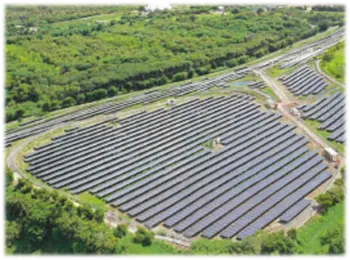
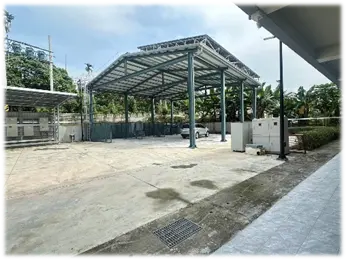
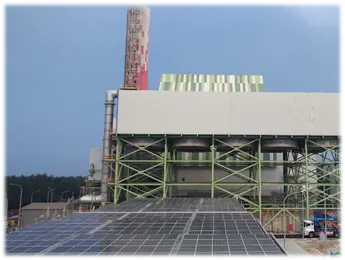
From 2017 to 2025, public environmental protection facilities (including landfills, sanitation teams, and incineration plants) have collectively achieved an installed solar capacity of 100.67 MW, meeting established targets. Using the policy-standard benchmark of 1,250 annual full-load hours, the estimated annual power generation is 126 million kWh. Based on carbon footprint data from the Environmental Protection Agency (0.606 and 0.00961 kg CO₂/kWh for grid electricity and solar PV respectively), this corresponds to an annual reduction of approximately 74,000 metric tons of CO₂e—equivalent to the carbon sequestration of about 194 Daan Forest Parks.
In line with relevant supporting measures, the administration will hold discussions and meetings to inventory potential landfills for development, share installment results and experiences, have experts scout, advise, and evaluate potential sites and submit reports as references for promoting the installation of solar power, and adding it to local environmental protection performance evaluations to enhance local government's motivation in promoting the policy, thus facilitating green transformation efforts.


- Data Source: Division of General Waste Management
- Publish Date: 2024-08-27
- Update Date: 2026-08-07