
 Related Topics
 Environmental Protection Facility Management
The administration’s Central Center of Environmental Management has established the “Central Regional Intelligent Environmental Governance Platform,” which integrates five major information sources into a single platform: pollution incident image monitoring, intelligent landfill monitoring, smart air quality sensors, water quality sensing data, and air pollution incident dispersion simulation. The platform provides functions including incident location identification, impact area assessment, hotspot lists, alert notifications, historical record inquiries, and management reports. Through the application of technologies such as AI imaging, sensor data, and data simulation, the platform strengthens real-time monitoring and early warning capabilities for environmental incidents involving air pollution, water pollution, and waste, shortens disaster response times, and provides information needed for decision-making and resource deployment, gradually establishing a regional technology governance system that is predictive, immediate, and effective.
Background and Transition ObjectivesIn the past, environmental pollution management relied on manual inspections and reporting, while monitoring data for air, water, and waste were dispersed across different systems. This often resulted in delayed reporting and reactive responses that allowed environmental incidents to escalate. Through the establishment of a physical monitoring center, the platform integrates central government entities (the administration’s Central Center of Environmental Management), local environmental protection agencies, and landfill management units (sanitation teams). By consolidating maps, images, and monitoring data into a single visualized interface, the traditional management model has been transformed into one focused on proactive prevention and real-time control.
The platform has already been connected to landfill systems in Miaoli County and Taichung City and incorporates AI-based thermal anomaly detection and infrared thermal imaging technologies. The system provides 24-hour continuous monitoring, operational area hazard warnings, automatic recording through smart weighbridges, license plate recognition access control, and landfill gas detection and warning functions. The system can detect abnormalities within approximately 15 seconds after smoke or flames appear and issue a notification within the “golden five minutes.”
Comparison of Disaster Prevention Benefits- Traditional model (Miaoli Xishan Landfill, July 2024): manual inspections required several hours to detect the incident. The fire burned for approximately seven days, affecting an area of more than 10,000 m², generating large amounts of black smoke and foul odors, producing 7,200 metric tons of carbon emissions, and consuming substantial firefighting personnel and resources.
- Smart model (Miaoli Xishan Landfill, September 2025): the infrared system detected and issued an alert within one minute. Fire extinguishment time was reduced to 4.5 hours, the affected area was limited to 100 m², and carbon emissions were significantly reduced to 192 metric tons, substantially lowering environmental impacts and resource consumption.
For air pollution incidents, the platform is connected to air pollution dispersion simulation data, including HYSPLIT. It can automatically generate a one-page report within five minutes. The report accurately identifies downwind dispersion directions and high-concentration warning zones, and automatically lists sensitive areas within the affected range, such as schools and hospitals, providing decision-makers with real-time fire scene environmental information and a basis for resource deployment.
In terms of water pollution prevention and control, water quality sensors have been installed in two wastewater collection areas, Niujiaokeng Creek and Qixing Drainage Channel, to continuously monitor pH, temperature, and conductivity. When abnormal data is detected, the system automatically sends alerts to business groups within the collection area, prompting operators to conduct self-inspections and equipment maintenance, thereby achieving self-management and preventive action.
By integrating AI imaging, sensor data, and data simulation, the platform has successfully shortened disaster response times and provided precise decision-making support. Going forward, it will continue to deepen cross-analysis of multi-source data related to air, water, and waste management. Through big data-driven approaches, it will advance pollution source tracing and targeted law enforcement, comprehensively establishing a regional technology governance system that is "predictive, immediate, and effective."
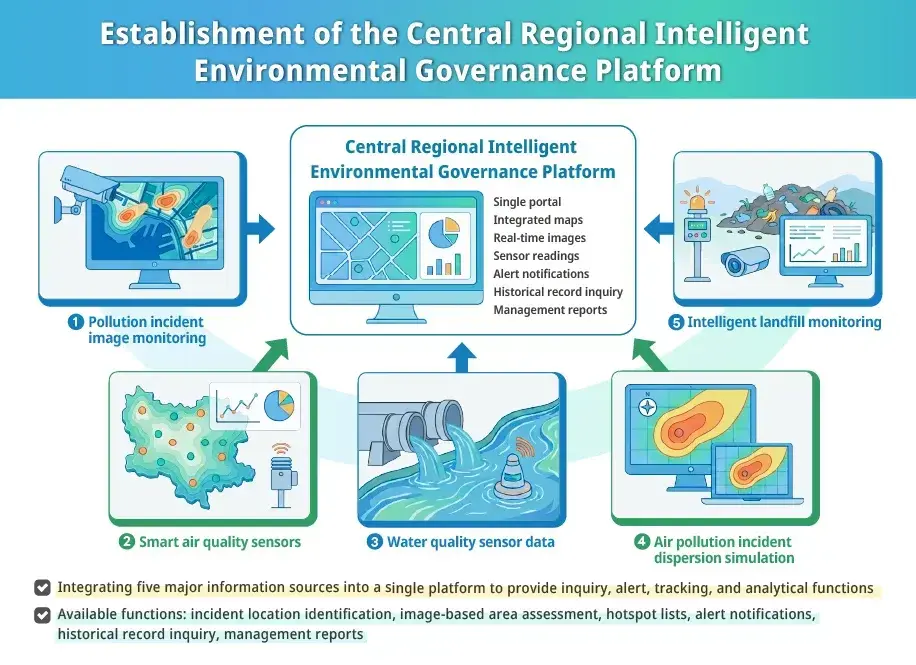


- Data Source: Central Center of Environmental Management
- Publish Date: 2024-12-10
- Update Date: 2026-10-29