
 New Restroom Culture
Did you know we visit the restroom six to eight times a day on average? Whether public restrooms are clean is not just an issue of dignity, but an indicator of civilization level. The Ministry of Environment is promoting a new wave of “restroom culture” reform, and we invite you to join and make toileting an enjoyment rather than an endurance!
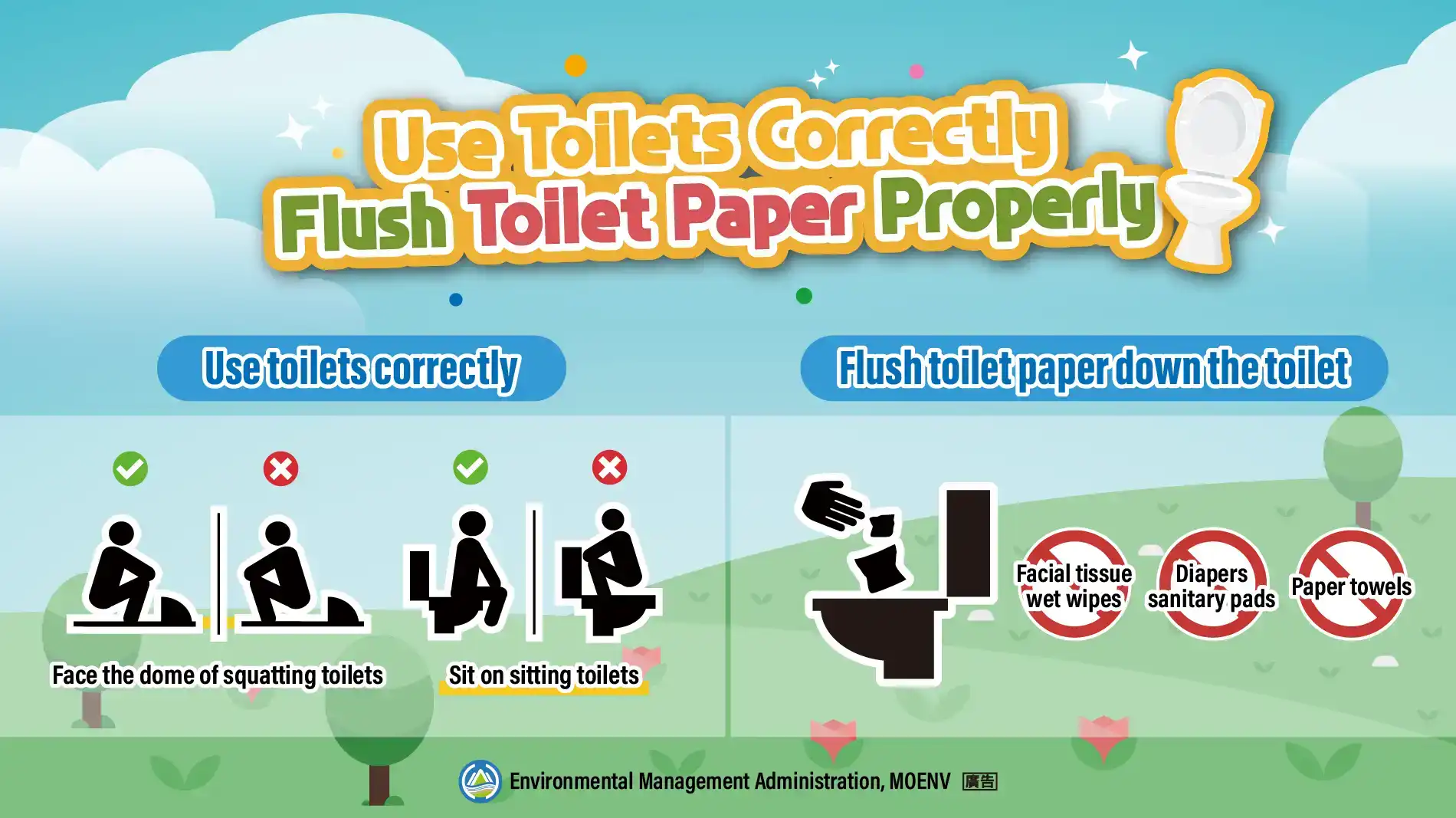
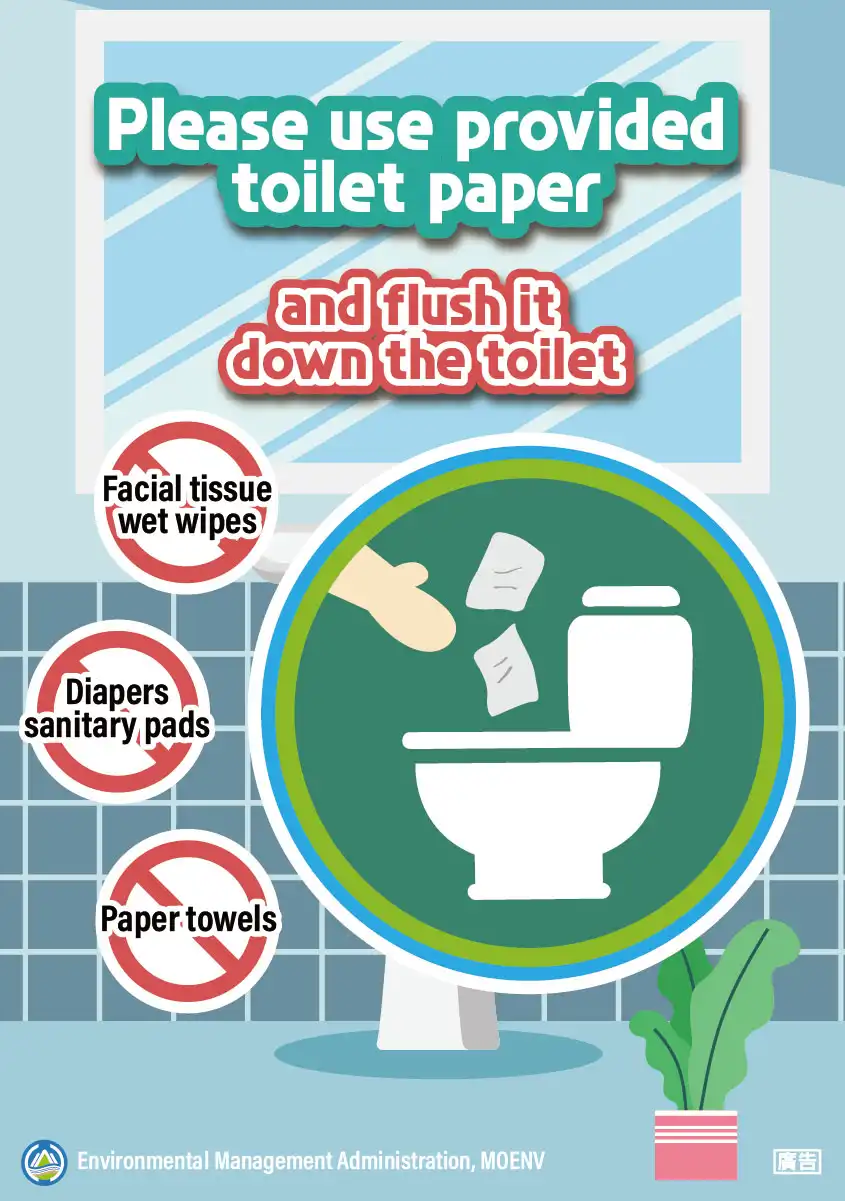
- (1) Do not fear! The toilet is not as fragile as you think. The public only needs to note the following points to safely flush toilet paper down the toilet! Furthermore, to enhance the environmental quality of Taiwan’s public restrooms, reduce the breeding of disease-carrying mosquitoes and flies, bacteria or infectious disease transmission, and elevate user comfort, the administration invites everyone to cooperate in promoting the policy of flushing toilet paper down the toilet!
- Pipe diameter decoded: the S-trap within the toilet has a diameter of around two inches, while the sewage pipe in the back is as wide as four inches. Paired with toilet paper's dispersibility and short fiber material, appropriate amounts of toilet paper flushed normally should pass through without a problem and not cause blockage!
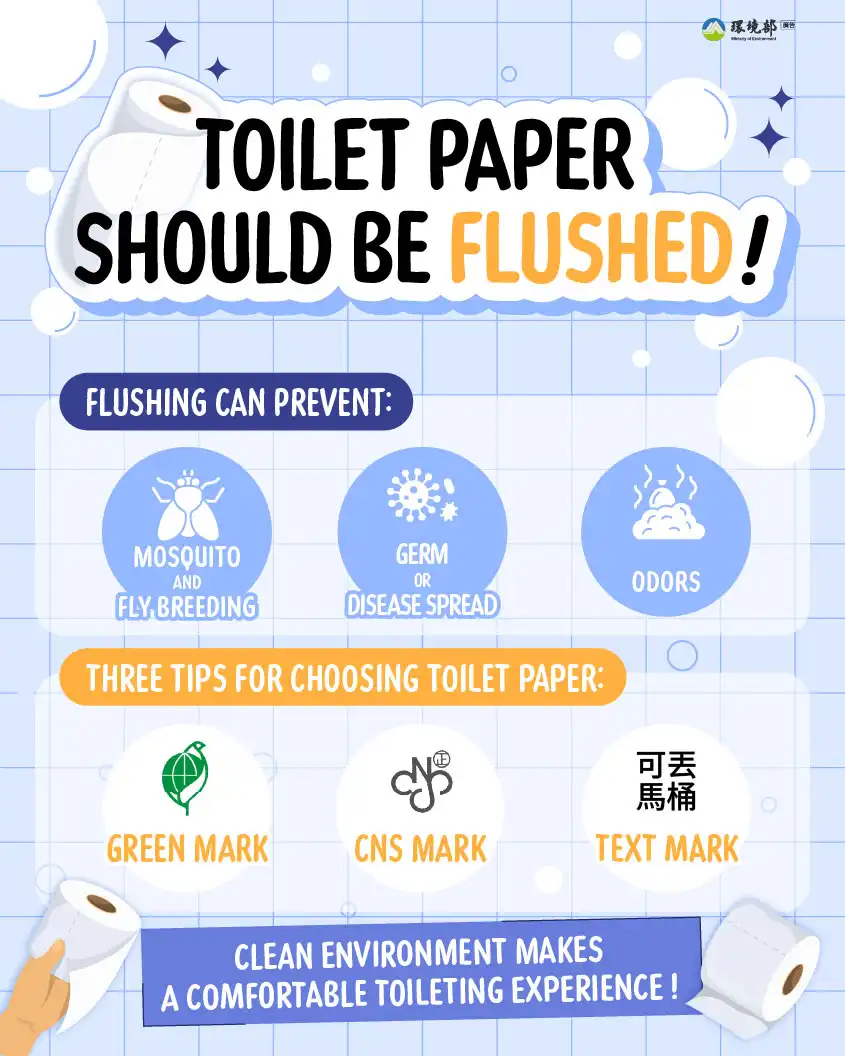
- Identify “dispersible” labels: Most toilet paper currently available on the market shows clear "Flushable" and "Dispersible in water" marks on the packaging. These products can be flushed down the toilet in appropriate amounts without worry.
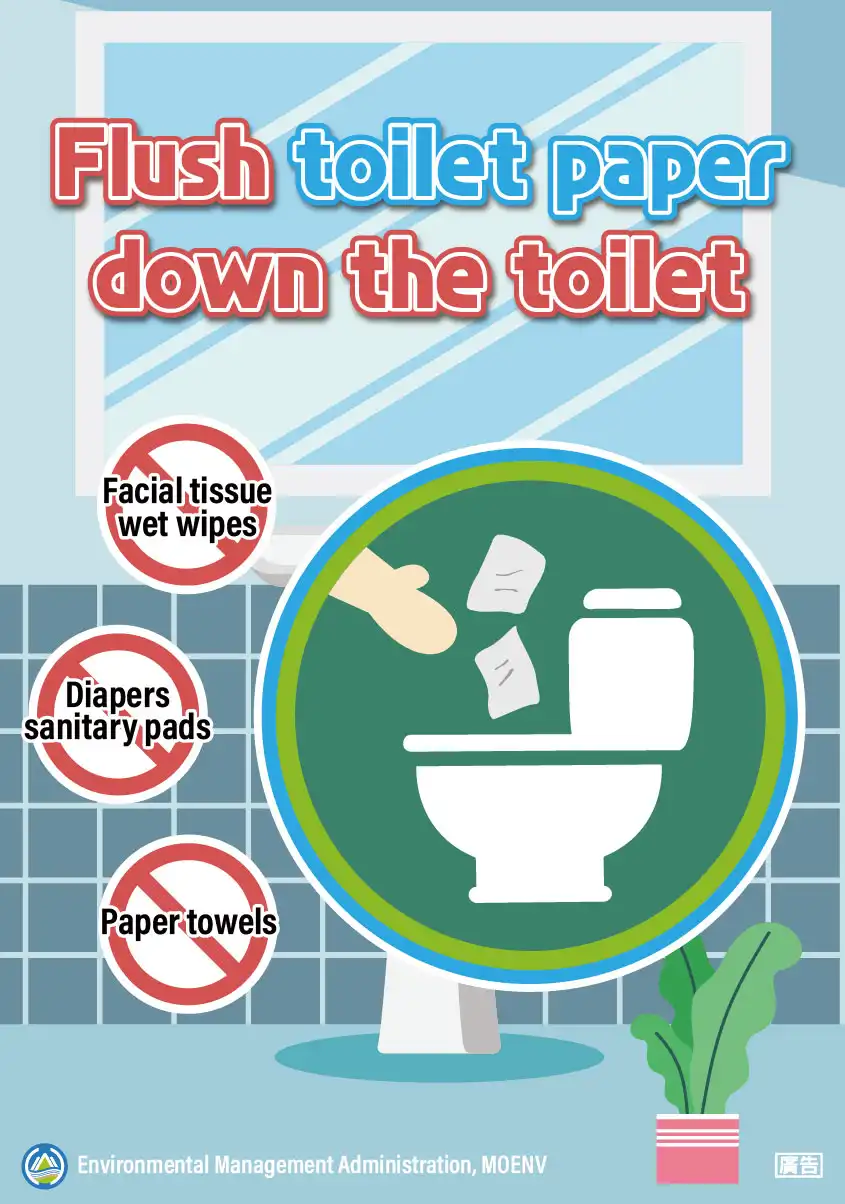
⚠︎Note: do not throw these items into the toilet to avoid severe blockage: facial tissues, wet wipes, hair, stockings, sanitary pads, rags, toys, plastics, condoms, cigarette butts, and food waste.
- (2) Mythbuster 1: does flushing toilet paper down the toilet cause toilet pipe blockages in old houses? Old drainage systems have four major structural problems, including:
- Narrowed pipe diameter: due to iron pipe corrosion or years of grease adhesion, the original four-inch pipe slims down to two inches; with less space, it naturally blocks easily.
- Insufficient slope: waterflow is not fast enough to push excrement, like a water slide that is not sloped enough, causing things to deposit halfway.
- Uneven joints: protruding pipe joints in old houses or tree root invasions easily trap paper fiber.
- Poor ventilation: buildings should have ventilation pipes installed to balance air pressure. If the pipes are blocked or ventilation pipes are not installed, it will exacerbate drainage resistance.
⚠︎Note: toilet paper can be flushed down toilets of old restrooms. Meanwhile, the overall plumbing structure of restrooms should be reviewed, ventilation systems repaired, and inspections and cleaning regularly conducted to jointly create and implement a new culture of civilized toileting.
- (3) Mythbuster 2: does flushing toilet paper down the toilet clog septic tanks? Septic tanks are actually not that fragile; their Achilles’ heels are oil and littering! The truth is decoded as follows:
- “Lump hardening” inside the septic tank: this is the most common cause! Bacteria in the septic tank decompose organic matter. If grease and food waste are poured into the toilet, upon entering the septic tank, they cool and solidify, combining with excrement to form "saponified lumps" as hard as rocks. This is what really causes blockage!
- Outlet/filter pipe blockage: if items that cannot be dispersed or decomposed, such as sanitary pads, wet wipes, or large amounts of hair, cause a blockage, foreign objects get stuck in the filter pipe between compartments of the septic tank, and water is unable to flow out. When the septic tank water level is too high, lower floor toilets start to bubble or gurgle.
- The septic tank is full: “capacity saturation” also causes blockage. Decomposed residue (septage) settles at the bottom of the tank and accumulates higher and higher as years go by without pumping. When there is insufficient space, solids that should have settled directly block the septic tank pipes. (It’s a sign that your septic tank needs pumping!)
⚠︎Note: flushing toilet paper down the toilet does not cause traditional, old septic tanks to block. Regular inspection of toilet pipes and septic tanks is recommended, as well as making adjustments to the frequency of cleaning (sludge pumping) as needed.
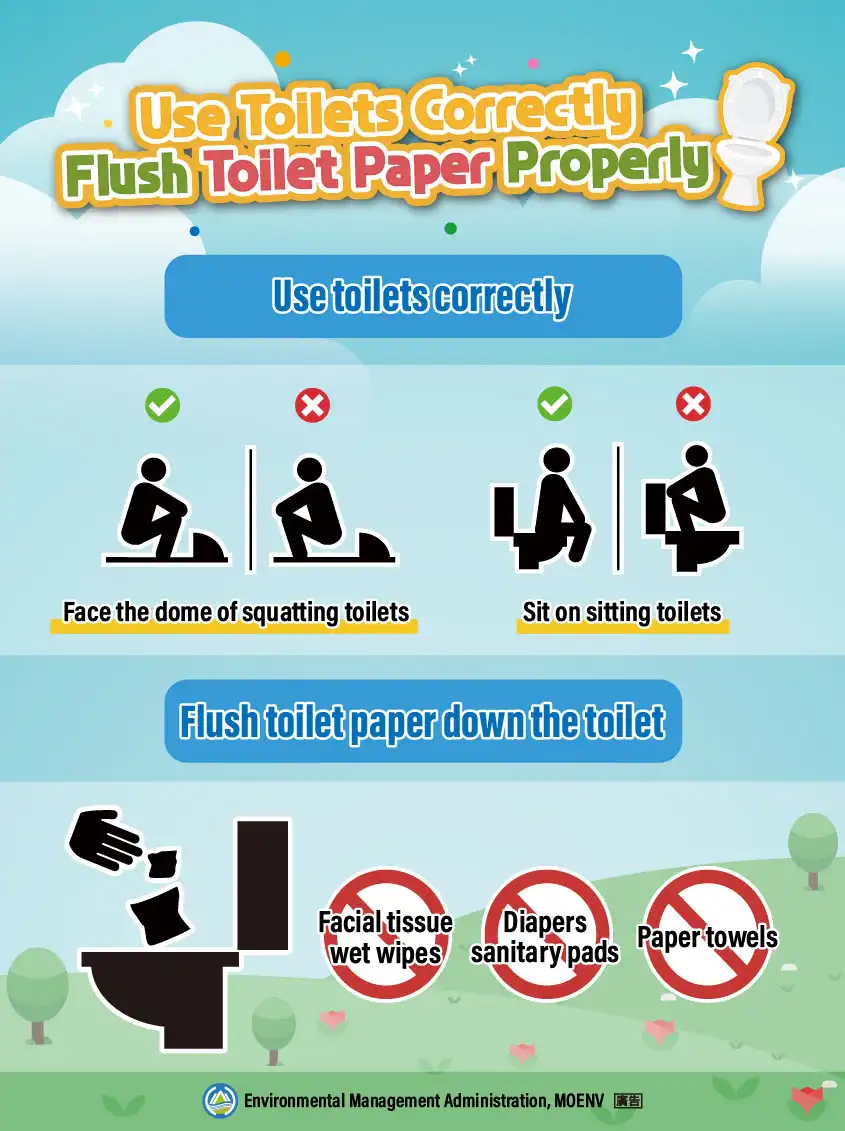
- (1) As Taiwan enters a super-aged society (population over 65 exceeds 20% of the total population, source: National Development Council), the number of elders around us is growing. Have you thought about how the simple act of “squatting down and standing up” for young people is actually a big challenge for elders, those with knee joint degeneration, pregnant women, or injured individuals with limited mobility? To make using toilets away from home more friendly, safer, and with more choices for everyone, gradually increasing the number of sitting toilets allows those who need sitting toilets to have sitting toilets, and those accustomed to squatting toilets to still have the choice of squatting toilets.
- Take care of everyone's needs, being considerate of vulnerable groups such as the elderly, pregnant women, patients, and those with limited mobility.
- Maintain diversity and respect, balancing the convenience and dignity of all types of users, offering diverse choices of toilets.
- Clean and easy to tidy: correctly using sitting toilets means excrement is less likely to splash outside the toilet, making the restroom floor easier to keep clean and tidy.
- (2) Worried that the toilet seat isn’t clean? The Ministry of Environment asks public restroom management units to provide sanitary supplies such as alcohol, disinfectant, or toilet seat covers. Before using the toilet, users can clean up easily by spraying, wiping, or covering toilet seats to sit without worry or the need to test their sense of balance.
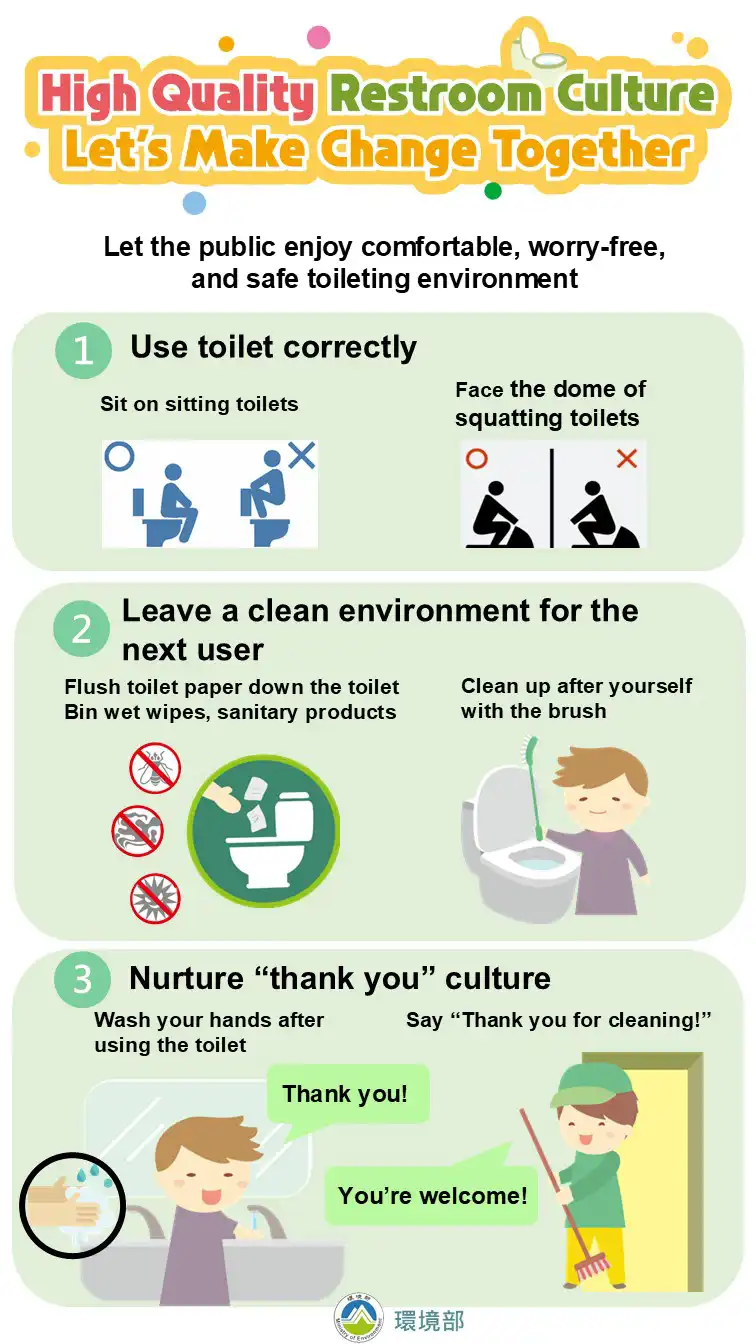
We invite everyone to make small toileting changes together. Just four simple small actions can greatly upgrade Taiwan’s restroom culture:
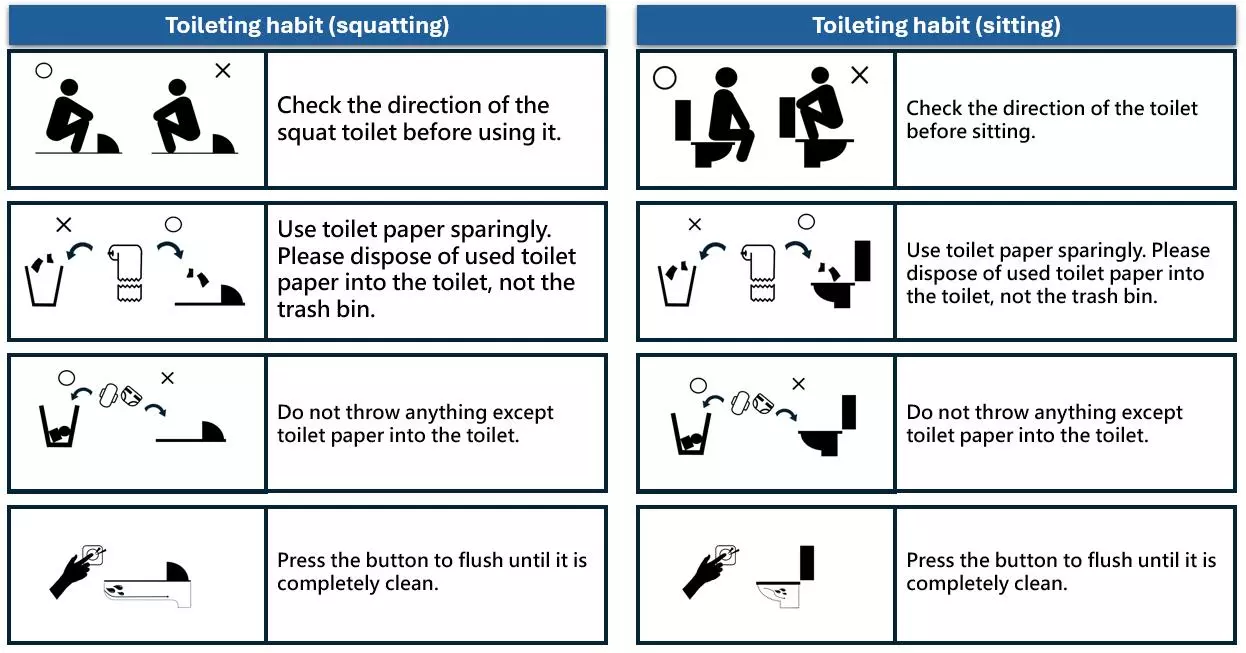
- Correctly use the toilet. Whether using a sitting or squatting toilet, correct usage allows excrement to accurately fall into the toilet without splashing outside. The floor can be kept clean and tidy, and the next person coming in will appreciate it!
- Clean up your own mess. If you accidentally dirty the stall, proactively clean it up, leaving a clean toileting environment for the next user, which can also reduce the burden on cleaning staff.
- After use, say to the cleaning staff, “Thank you for keeping the restroom clean.”
- Please yield use of the restroom to those with mobility impairments and those needing sitting toilets.
When out and about, emergencies are inevitable. Where is the restroom then? After using the restroom, if you feel the environment needs cleaning, how do you let the management unit know? The Ministry of Environment has two restroom navigation tips to share.
- (1) Skill 1: When out and about, grasp where public restrooms are in a second!
Pick up your phone, there are two super simple methods:
- Search on the web: enter “find public restroom” in your phone search, and nearby public restrooms will immediately appear.
-
Download the application「 Environment Info Push 」
These two services not only provide public restroom location queries but also cover detailed information such as public restroom names, categories, facilities and equipment, regulatory grades, and opening hours. They can help everyone quickly find nearby, suitable, and convenient public restrooms during a trip, helping one relieve oneself and feel refreshed.
- (2) Skill 2: After using the restroom, your opinion matters!
After using the restroom, if you feel the environment was super clean, or find areas needing improvement, please do not hesitate to use your phone to scan the QR Code posted outside the public restroom. The screen will redirect to the “Public Restroom Evaluation System,” where you can provide feedback on that public restroom. Upon receiving the report, the public restroom management unit can dispatch personnel for improvement, maintaining a clean and tidy public restroom environment.
- (3) Skill 3: We value your feelings immensely, and will tell you immediately once handled!
We value your opinions immensely, and upon resolving an issue, we will immediately send an email to let you know (you can choose to “Receive reply on resolution” when reporting); or go to Environmental Sanitation Management System (ESMS) - Public Restroom - Public Opinion Reporting Opinion to query the status of issues.
Any questions or suggestions about “New Restroom Culture” can be sent through the Minister’s Mailbox .
Flushing toilet paper down the toilet can reduce many environmental hygiene problems. Benefits include:
- Reducing mosquito and fly breeding.
- Reducing the spread of germs and diseases.
- Reducing odors in restrooms.
- Enhancing maintenance workers' and cleaners' hygienic safety.
- Enhancing restroom environment quality; users feel more comfortable as well.
Old drainage systems have four major structural problems, including:
- Narrowed pipe diameter: due to iron pipe corrosion or grease adhesion, the original four-inch drain pipe may only have two inches of space left, similar to vascular sclerosis.
- Insufficient slope: insufficient waterflow velocity causes solid matter to not be carried away smoothly and thus easily deposited in the pipe.
- Uneven joints: protruding pipe joints in old houses or tree root invasions easily trap paper fiber.
- Poor ventilation: buildings should have ventilation pipes installed to balance air pressure. If the pipes are blocked or ventilation pipes are not installed, it will exacerbate drainage resistance.
Therefore, toilet paper can be flushed down toilets of old restrooms. The best policy is to review the overall plumbing structure of restrooms, repair ventilation systems, and clear pipes regularly. It is recommended that public restroom management units and the public face the problem of aging pipelines, promote replacing old systems, and jointly create and implement a new culture of civilized toileting.
Reference: Chairman Kuo Chi-tz, Taiwan Institute of Property Management
The causes of traditional, old septic tank blockages are as follows:
- "Lump hardening" inside the septic tank: this is the most common cause of blockage. A septic tank is not a simple water tank; it relies on bacteria to decompose organic matter. When grease and food waste enter the septic tank, they cool and solidify, combining with excrement to form "saponified lumps" as hard as rocks. These hard lumps float on the surface or accumulate at the water inlet, causing the toilet to flush poorly, or even back up completely. Therefore, please do not throw food waste into the toilet.
- Outlet (filter pipe) blockage: a septic tank is usually divided into three compartments. After the water flows through layers of precipitation, it is finally discharged from the outlet. If items that cannot be dispersed or decomposed, such as sanitary pads, wet wipes, or large amounts of hair, are flushed and cause a blockage, foreign objects get stuck in the filter pipe between the tanks, and water is unable to flow out. When the septic tank water level is too high, lower floor toilets start to bubble or gurgle.
- The septic tank is full (time to pump septage): "capacity saturation" also causes blockage. Decomposed residue (septage) settles at the bottom of the tank and accumulates higher and higher as years go by without pumping. When there is insufficient space, solids that should have settled directly block the septic tank pipes.
Therefore, flushing toilet paper down the toilet does not cause traditional, old septic tanks to block. Regular inspection of toilet pipes and septic tanks is recommended, as well as making adjustments to the frequency of cleaning (septage pumping) as needed.
Reference: Chairman Kuo Chi-tz, Taiwan Institute of Property Management
The following characteristics can be observed to determine the problem:
- If only a single toilet is blocked, and other floors are normal, it may be a local pipe blockage.
- If lower floors bubble/back up, toilets also bubble when flushed, or even emit odors, it may be that the septic tank is blocked or full.
- If flushing is slow throughout the building, and every toilet on every floor performs poorly, there may be an abnormality in the main pipe or septic tank.
Therefore, when public restroom management units and the public encounter the above situations, it is better to seek help from professional experts in related fields.
Reference: Chairman Kuo Chi-tz, Taiwan Institute of Property Management
- Toilet paper provided in public restrooms should comply with national standard dispersibility regulations (CNS 1091). Continuously advocate for and implement flushing toilet paper down the toilet and setting up covered trash cans, unify promotional content such as signs or slogans and post them in restrooms so that users can understand at a glance. Vending machines outside public restrooms should sell dispersible toilet paper instead of facial tissues, providing them for public purchase and use and assisting in the promotion of correct restroom culture and etiquette.
- Post clear and easy-to-understand slogans or icons inside public restrooms to guide the public to follow correct toileting guidelines, promote the use of an appropriate amount of toilet paper, not throwing foreign objects into the toilet, reducing pipe blockages and facility damage, maintaining environmental cleanliness and cherishing public restroom facilities, etc., elevating the public's awareness of maintaining public restrooms.
- Currently, toilet water traps are two inches, and sewage pipes are 4 inches wide. Both toilet paper and excrement can pass through the water trap, and will certainly not cause pipe blockages. Old pipes are not the cause of blockages; blockages are often caused by uncleaned scale. Public restroom management units should regularly inspect pipes, clean pipes, and if pipes rust, they must be replaced.
- When using public restrooms, follow the signs to use the toilet correctly, use an appropriate amount of dispersible toilet paper and flush it down the toilet, throw other foreign objects into the trash can, and help maintain drainage pipes and a clean public restroom environment.
- Based on experience, items that cause blockage include hair, stockings, sanitary pads, food waste, rags, toys, plastics, condoms, and cigarette butts. As these are not toilet paper and can cause blockage, they should not be flushed down the toilet.
- Most toilet paper currently available on the market shows clear "Flushable" and "Dispersible in Water" marks on the packaging. These products can be flushed down the toilet in appropriate amounts without worry.
- On Aug. 12, 2025, the Ministry of Environment amended the "Guidelines for Promoting Flushing Toilet Paper" and notified various ministries, councils, offices, and public restroom management units within cities and counties to jointly promote it. The guidelines state that toilet paper provided in public restrooms must comply with national standard CNS1091; an appropriate amount of public restroom toilet paper should be flushed down the toilet after use; vending machines outside public restrooms should sell toilet paper complying with national standard CNS1091; and items that cannot be flushed include hair, stocking, sanitary pads, food waste, wet wipes, rags, toys, plastics, condoms, and cigarette butts, etc. to avoid blocking pipes or septic tanks.
- The Ministry of Environment subsidizes local governments to construct or repair public restrooms, improve hardware facilities, and elevate public restroom environment quality. It has also formulated a promotion plan for elevating restroom culture, advocating correct toilet use, flushing toilet paper, cleaning up one's own mess, treating oneself as the next user, and maintaining a clean and comfortable restroom to provide users with a comfortable, safe, and dignified toileting environment. Currently, there is a wide variety of signs and slogans posted inside public restrooms. Currently, there are countless styles for signs and slogans posted within public restroom stalls; this plan provides templates of signs or slogans for public restroom management units to utilize and post in restrooms to advocate restroom culture and make it clear to users at a glance.
- The Ministry of Environment also requested public restroom management units that vending machines outside public restrooms sell dispersible toilet paper instead of facial tissues for public purchase.
To create comfortable, safe, dignified, and high-quality restroom environments, move away from the old image of dirty and smelly public restrooms, and make people willing to use them, the Ministry of Environment promoted the "Promotion Plan for High-Quality Public Restrooms and Beautiful Environments" from 2019 to 2024. The plan subsidized local governments in systematically replacing and renovating old public restrooms, promoting tourism value and high-quality restrooms, and improving restroom culture. So far, NT$1.65 billion has been provided in subsidies, and 4,290 public restrooms have been replaced or renovated. Over the next six years, NT$5.524 billion will be invested to build or renovate 2,500 public restrooms and strengthen management of more than 45,000 public restrooms. Public restrooms that have not reached the "Superior" level will be improved through facility upgrades and stronger management, while those that have reached the "Superior" level will incorporate local cultural characteristics to create distinctive restrooms. The ministry will also promote the action plan to double gender-friendly restrooms and improve restroom culture.

- Data Source: Division of General Planning
- Publish Date: 2026-04-29
- Update Date: 2026-06-18