
 New Urban Highlights: Ministry of Environment announces results for 11 distinctive public restrooms
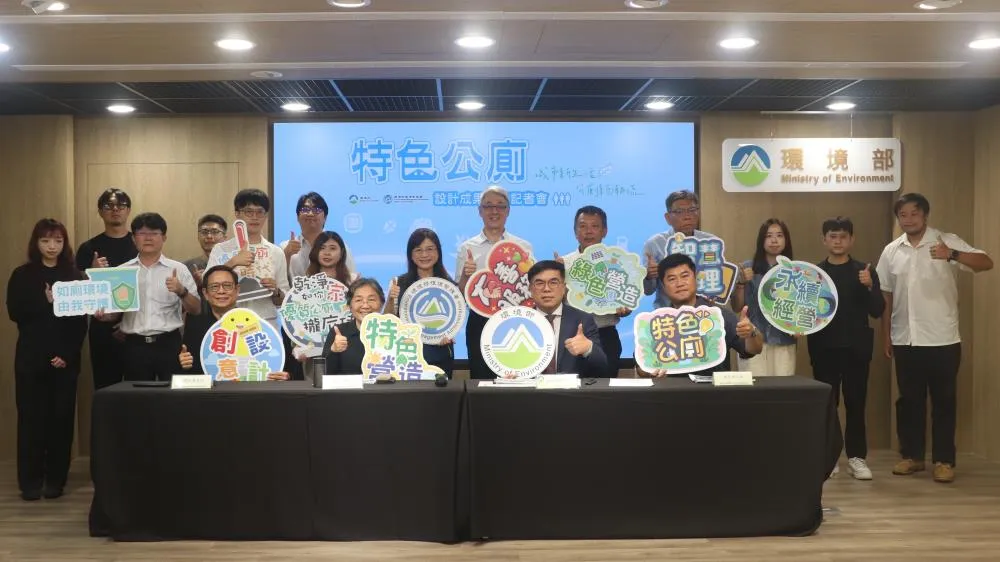
To elevate the overall environmental quality of Taiwan’s public restrooms, implement the United Nations Sustainable Development Goals (SDGs), and ensure that all individuals enjoy a comfortable, safe, and dignified restroom environment, the Environmental Management Administration (EMA) of the Ministry of Environment (MOENV) held the “Distinctive Public Restroom Design Results Press Conference” on May 29. The design results of 11 subsidized distinctive public restrooms nationwide were shown to the public, demonstrating the innovation of local governments in integrating local culture with environmental aesthetics, successfully transforming stereotypes of public restrooms.
The EMA stated that since the launch of the “Distinctive Public Restroom Promotion Plan” in 2025, the design concept has focused on six key principles: distinctive features, creative design, green creation, smart management, friendly service, and sustainable operation. Through a competitive subsidy mechanism, local governments are encouraged to adapt to local conditions and transform functional facilities into environmental landscapes with aesthetic value and unique characteristics.
At the event, designs of 11 distinctive public restrooms nationwide were showcased, spanning diverse locations including tourism hotspots, parks and green spaces, and transportation hubs. The integration of architectural design and the environment allowed for the optimization of hardware and facilities as well as the redefinition of public restrooms’ spatial value. Three benchmark teams were invited to share their design concepts. The public restrooms at the Kaohsiung Music Center utilize transparent bubbles to shape a lightweight space, allowing restroom audio and lighting to synchronize with performance tracks, realizing the fusion of creative design and artistic atmosphere; the Xingda Harbor Fisherman’s Market public restrooms adopt the concept of “a fully loaded fishing boat returning to port,” combining wavy sandblasted glass to create day and night light and shadow variations, fulfilling the spirit of distinctive features; the Green Tunnel public restrooms in Gukeng Township, Yunlin County draw from the concept of “forest symbiosis,” harmonizing the architecture with the local landscape and demonstrating the integration of green creation and environmental sustainability.
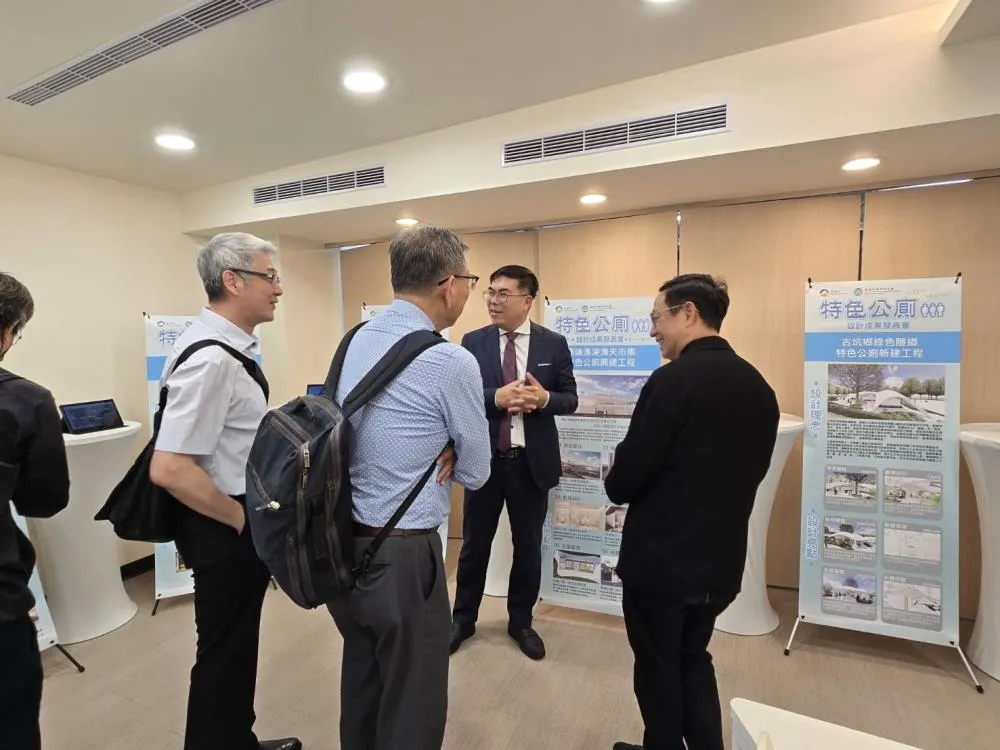
The showcased results included multiple applications of technology and aesthetics. For example, the Guanxin Park public restrooms in Hsinchu City evoke the image of a semiconductor technology hub; the Nanliao Old Port public restrooms in Hsinchu City introduce smart management systems for fall detection and prolonged occupancy sensing; the Letian Park public restrooms in Taichung City innovatively utilize 3D printing construction techniques to create cave-dwelling architectural highlights; the Love River public restrooms center on “waterfront flow,” combining curved architecture with perforated plate facades to create layers of light and shadow; the Kaohsiung Hamasen Railway Cultural Park public restrooms use shipping containers to recreate a historical railway atmosphere; the Tainan Yuejin Port Park public restrooms draw from the concept of “crescent moon,” harmonizing the architecture with the local landscape; the Kaohsiung Asia New Bay Area waterfront public restrooms feature detached walls that introduce natural lighting and convection and are equipped with smart management systems to enhance maintenance efficiency; and the Kaohsiung Aozihdi Forest Park public restrooms combine solar energy with rainwater harvesting facilities while presenting “carbon footprint” imagery through floor tiles and vegetation to implement green energy and carbon reduction. All 11 projects at the venue were explained using X-stands and tablets for various county and city governments and environmental protection bureaus and departments to observe and learn from.
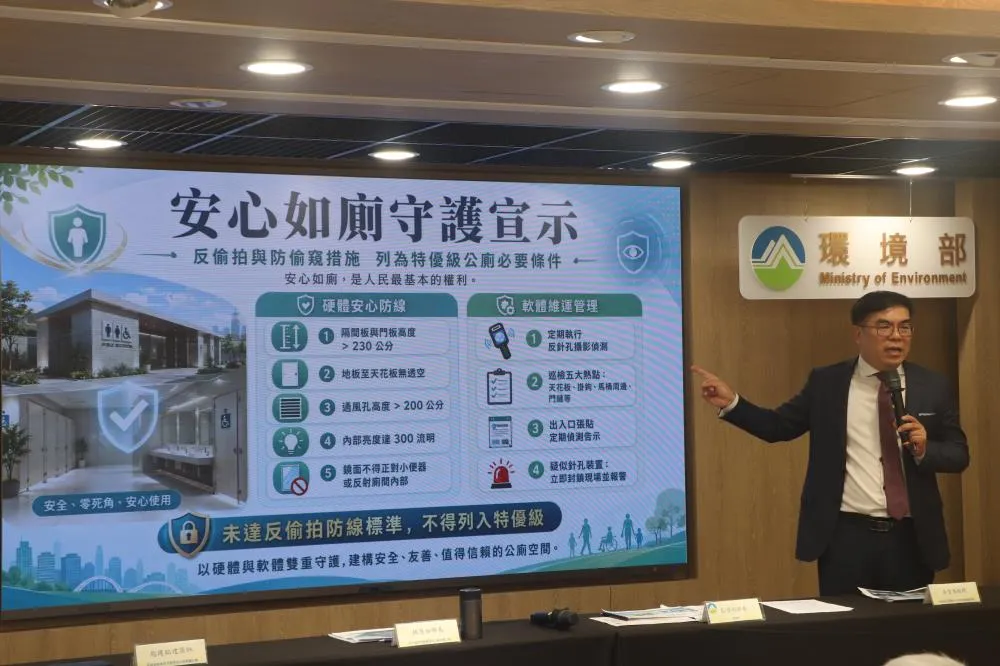
The MOENV emphasized that to protect the public’s privacy, public restroom management units must improve anti-peeping designs. In terms of hardware facilities, the distance between the lower edge of restroom doors and the ground, as well as the height of partitions and ventilation holes, must be properly planned; meanwhile, mirrors must never face urinals directly. Furthermore, management units must regularly conduct hidden camera detection, inspecting critical areas such as ceilings, hooks, and areas around toilets; if suspected hidden camera devices are discovered, the public restroom must be locked down immediately and reported to the police to create a safe, blind-spot-free space. The ministry also announced pending revisions to the “Guidelines for Public Restroom Regulation and Maintenance Management,” which will require public restroom management units to regularly conduct hidden camera detection, maintain records, and post notices reading “This public restroom undergoes regular hidden camera detection and daily inspections” in conspicuous locations at entrances and exits. This will be incorporated as a requirement for public restrooms to be rated as excellent.
The promotion of distinctive public restrooms serves as a model for the transformation of new aesthetics in public construction, representing not only a leap in environmental quality but also a concrete manifestation of the integration of local governance, urban aesthetic thinking, and sustainable development. In the future, local governments will be guided to deepen sustainable management mechanisms. With this as a starting point, more innovative resources will be encouraged, moving public restrooms away from the framework of traditional NIMBY facilities and elevating them into vital vehicles for displaying urban warmth, civic dignity, and environmental aesthetics. At the same time, by implementing anti-peeping and anti-hidden-recording measures in public restrooms, the public’s privacy and peace of mind can be protected while enjoying public spaces that combine comfort, friendliness, and aesthetics, elevating safe, high-quality restroom culture into a new highlight of Taiwan’s urban governance aligned with international standards.
- Data Source: Environmental Management Administration
- Publish Date: 2026-05-29
- Update Date: 2026-06-22